May 28, 2017

Biutiful

Director:  Alejandro Gonzalez Inarritu
Length:  148 min.
Released: 2010


The latest film from the Mexican director Alejandro Gonzalez Iñarritu received much critical acclaim.  Innaritu's films tend to use multiple character subplots concentric or overlapping circles to tell a larger story.  As he did in Babel, Innaritu uses several different cultural groups, but in Biutiful he places them all in the same city (Barcelona).  

Inarritu sets his story in a world invisible to most people.  His main character, Uxbal (played by Javier Bardem, who was nominated for an Oscar), is a go-between for several illegal operations: Chinese sweat-shops, operating a sweat-shop warehouse who pay the Spanish police to
Uxbal also earns a little money as a medium helping people interpret the last needs of their loved ones as they die.

He does his best to help people, but sometimes things go horribly wrong.  His personal life takes a bad turn, as a bladder problem becomes much more serious.  He worries that his wife, who suffers from manic depression, will not be able to care for their two young children.  He is unable to confide in his brother, who is involved in other projects: drugs, strip clubs, and construction.  The cemetery where their father is buried will be turned into a shopping center, and the body must be cremated.

All the characters in Biutiful struggle to keep themselves afloat.  They are doing the best they can to survive.  It is easy to criticize from a distance and say the characters are part of a seedy underground, that the have made bad choices.  These people are doing the best they can with the resources they have.

Most of the scenes take place inside: in basement warehouses, in cramped and dirty apartments, in hospitals. For many of these people, being outside means being exposed and vulnerable.  One of the few scenes outside takes place on a major square where illegal African immigrants sell goods (illegally-manufactured by the Chinese illegal immigrants in the sweat-shop warehouses).  The police arrive in a major raid, causing a chain of events which leads to a breakdown in the whole operation.

Corner Gas

Director:  Brent Butt
Length:  30 min.


tt0397138.jpg

Stand-up comedians seem to enjoy turning their one-liners into thirty-minute episodes of laughs.   Brent Butt penned a sitcom based in his home province of Saskatchewan, where he imagined he would still be pumping gas if he hadn't become a successful stand-up comedian.  The show features a cast of eight, centered around a gas station and a cafe. Without all the usual drama of most shows, Corner Gas focuses all its efforts on snappy one-liners, idiomatic expressions both in and out of context, and quick repartee between its characters.  It's like doing a comedy routine with a whole cast of sidekicks, straight men and dummies.  Every character is both well-rounded and exaggerated. Famous Canadians make cameo appearances in many episodes.

Corner Gas was an amazing success in Canada (where a show rarely lasts more than 100 episodes), survived for five seasons, and was exported beyond Canada. Some of the actors were well-known before the show, but for most Corner Gas was their biggest gig. The show was so successful that they made a feature-length film in 2014, though it was not as big a hit as expected.  

The gas station and diner set so popular as a photo-op for people driving through Saskatchewan that the fake buildings remained up long after originally anticipated. The set (in Rouleau, Saskatchewan) was finally destroyed in 2016, because it was no longer safe for the public to be near.


Passengers

Note: Don't read this review until you've seen the film. 

Director: Morten Tyldum
Released: 2016
Main actors:  Jennifer Lawrence  (Aurora)
                      Chris Pratt  (Jim)

Normally I don't feel it necessary to comment on big American box office films. Also, as I hardly ever actually see a film in a theater, I'm usually pretty late to the first-run films, so by the time I see it everyone else already has. But after reading several negative reviews online, I felt compelled to contradict.

I just saw Passengers. I had avoided selecting it for weeks because the premise seemed to be more a romantic comedy, and I wanted to see more compelling stories. I had not read any reviews about it, so my bias came uniquely from the one-sentence summary I read. I am not a devoted sci-fi or fantasy viewer or reader. I am not completely devoted to beautiful Hollywood actors or swayed by fancy action sequences. I finally chose it because I was intrigued to see what is was really about.

The premise of transporting people to a distant planet is fascinating to many people, and Passengers presents the potential risks of such ventures. The set design was carefully constructed to accurately depict what would likely be found on board a commercial vessel bound for such a voyage. The opulent state rooms bring a little bling to an otherwise blinding world of white and gray. The calculated computerized responses are spot-on, and completely unhelpful when help is really needed. The android bartender is the perfect combination of comedic relief and antagonistic betrayal. It was a great decision to avoid giving Aurora the cliché of a writer (glasses and hair wrapped loosely in a bun). Instead, her clothing choices are very normal for women traveling on cruises. Jim also dresses normally: no need to wear extra-tight shirts, baseball caps, cargo shorts or flannel.

I was pleasantly surprised by Passengers. I am often intrigued to look online after viewing a film to learn more about it and read some reviews. I was disgusted to read multiple reviews completely panning the film. I understand that film critics feel compelled to make clever insights, find comparisons with other films, and highlight improbabilities. The sheer volume of film viewing almost requires them to pursue their initial instinct for a review.

Passengers was directed by Morten Tyldum, who is Norwegian, and who has made several Norwegian films. His English film The Imitation Game (about the Enigma machine and Alan Turing) won world-wide acclaim. Passengers did not receive the same fate. In my opinion, both The Imitation Game and Passengers are worthy films.

Passengers is clearly a fairy tale, and makes no claims to have complicated plot twists. Aurora (Jennifer Lawrence) is Sleeping Beauty, and Jim (Chris Pratt) the one who stumbles across her in the forest (of tree-shaped passenger pods). The film is not necessarily targeted to any specific group, which is probably why they chose to make it a big Hollywood production, to reach everyone. (Critics seem to be upset that it's both, or neither.) Remember fairy tales are light-hearted stories meant to warn about dangers, defeat obstacles and conclude with a happy couple. Passengers perfectly follows this path.

Here are some of the major criticisms about Passengers:

The stars are popular and attractive Hollywood actors. Yes, Jennifer Lawrence and Chris Pratt are beautiful actors. It also seems completely plausible that the large commercial company depicted in the film would want beautiful people to sign up to colonize a new planet. They are also good actors, and they do show the dilemmas one would encounter stuck in a difficult situation. Human nature draws us to attractive features, and Jim's selection of Aurora is instinctual. His decision is

Chris Pratt lacks dimension.  Chris usually has roles with great one-liners meant to lighten the mood as giant predators chase or surround him. As other critics have pointed out, he does posses the traditional look of an American astronaut and a jock, but Chris brings those ideals back down to the human level. He perfectly portrays Jim, the mechanical engineer who has endearing charm and lighthearted creativity to counteract a lack of confidence. What's the problem with changing our perception of engineers to include ones who want to maintain their physique ?

Jennifer Lawrence prances about in a swimsuit and tank top.  This is not a horror film; Aurora is wearing typical clothing to swim and jog around the ship. Exercise is a great way to stay in shape, maintain a routine, and contemplate. Astronauts spend ample time exercising; it's a constant effort to combat muscle loss. Jim had a year to adjust to his situation; Aurora is expected to immediately accept her fate ? Do critics complain about Claire running in House of Cards ?  

The characters spend all their time dining and playing.  Traditional cruises contain restaurants, basketball courts, pools, arcades and jogging paths. These are normal vacation and travel activities. Why should we assume travel to space would be different ? It's a great notion to give passengers an opportunity to don space suits and walk outside, giving them some momentary freedom and their first chance to really experience space. Exactly what commercial enterprises would offer their guests, like zip-lines and bungee-jumping. One interesting aspect no one mentions Jim can develop basic language skills through dining at Japanese, Mexican and French restaurants.

The film feels lost and going nowhere.  The premise is not really about getting to the destination (which never veers off course); it's about the tough decisions when something goes wrong en route. This is a road movie about humanity in an inhuman world. Perhaps it is more a European perspective to make a film less about action than about the difficult decisions humans face. The American film audience seems to prefer mind-numbing action sequences.

It's really just a new Titanic.  Yes, comparisons are inevitable to other sinking ships. Space travel limits the options for rescue though. The economic differences between Aurora and Jim are realistic, and hardly contrived. Jim is not poor, and we're not supposed to feel sorry for him. He was recruited for his skills and compensated with the lowest-fare option. Where's the surprise there ?

There are several sequences like Gravity. Yes, the actors have tethered spacesuits and difficulties with on-board systems. This will likely appear in many films set in space.

Limited stunning visual effects. All the critics mentions the pool scene with the loss of gravity. American audiences always want more. This film is not about endless action scenes. Get over it!

Pessimism pervades.  There has always been a sense of unfailing optimism within the American space program, but as a government program, there was accountability to the public. Now that it is becoming almost completely commercialized, it can forge ahead almost without limits. This idealism could be viewed as naïve, and perhaps Morten Tyldum (the Norwegian director) is inserting some of his concerns (though he did not write the script).

It's creepy. Most people seem to view Jim's decision to awaken Aurora as immoral. They state he is robbing her of a life on the new planet. In reality, Aurora does not want to live there: she wants to write a story and return to Earth. In her own way, she is selfish. When he changes Aurora's plan, he liberates her to actually live.  

In my opinion, the creepiness is flying a craft for hundreds of years with no beings (human or robotic) in charge of monitoring system failure. This is the audacity of all disaster movies, to assume nothing could possibly go wrong. Autopilot on planes doesn't mean the pilots sleep...

The ending is contrived. People complain the film ends in a lovey-dovey heart-warming relationship. It brings life to a world waiting to live. It is not implying morality nor assuming everyone would make the same choice. All films must end, and this one should leave the viewer pondering. It seems the critics don't want to think.

--------------------------------------------------------------------------------------------------------------------------
Films are a medium of storytelling. They use fictional characters to demonstrate flaws and warn against potential dangers. They give us opportunities to question our own decisions, and show us alternative ways to live. They are meant to entertain. It's not that we must expect less from movies, it's that sometimes they may expect more from us.

There will inevitably be more films about space travel, probably even disaster films. I am sure they will have great cinematic effects and large explosions. They will probably feature famous actors with various levels of sculpted features. I hope that critics in the future can look back at Passengers with better appreciation.


February 27, 2015

Reflections on Oscars 2015

We just had the Oscars this past weekend and perhaps it is revealing that Birdman received top honors in so many categories and Selma was honored only with a torch song. The obvious criticism is that the Academy is self-centered, and interested in stories about life in the movie business. The same weekend and without nearly as much attention outside its own country, France had the Césars ceremony, where one film also vastly outshone all others, but of an entirely different nature. Timbuktu was a co-production between France and Mauritania, and focuses on life forever changed by Islamic extremists. This more accurately reflects life in our world than one where men fly.

At the Oscars, Timbuktu was lumped with the other "foreign films". But really, Ida had to win; just as 12 Years a Slave had to win last year. It's America's strange place in the world; between Israel and Palestine the US will always choose Israel, because we are a nation of more Jewish immigrants than Arabic immigrants, and so many people of Jewish heritage run our great institutions: banks, jewelers, films, delis that we feel guilty, that we're "letting them down".

France, on the other hand, is in the opposite situation. With more Arabic immigrants and record numbers of Jews fleeing to Israel, it truly struggles to deal with populations who want to display their religion in a country which keeps trying to tell everyone not to mix up religion and matters of state.

CitizenFour and American Sniper represent America's situation, but it's hard to know if everyone could tell the difference between the heroic filming of the documentary and the controlled filming of the "heroic story". It will be interesting to see which topics are covered next and chosen by Hollywood's elite to represent the "best" in American cinema.


May 8, 2012

Tell Them Anything You Want: A Portrait of Maurice Sendak

tt1509268.jpg


Director: Lance Bangs & Spike Jonze
Released:  2009

On the day of Maurice Sendak's death, it seems most appropriate to profile a documentary made about Sendak.  Done as a series of candid interviews with Sendak at his house in Connecticut, directors Lance Bangs and Spike Jonze take turns asking questions and prompting Sendak to discuss certain issues.  

Maurice Sendak is best known for the popular children's books Where the Wild Things Grow and In the Night Kitchen, but he'll be the first to point out his work is not intended for children or adults.  Inspiration for his stories came from a difficult childhood being sickly, ignored and punished, but also from the many games and stories he and his brother made. He was particularly affected by the kidnapping of the Lindbergh baby, and his personal story and subsequent children's book are touching. His sense of humor is on the darker end of the scale, a product of family legacies lost from European concentration camps. He shows the ugliness and realities of childhood most children's books ignore, the  excitement of mischief and the curiosity of what goes on in the big, scary, wonderful world.

Though the film is only 39 minutes, there is much packed into it. Sendak describes his life, influences and many artistic creations. His fear of death permeates throughout the film, even as the filmmakers try to convince him of the many positives in his life.  The title works as either a statement directed to or from Sendak, and perfectly conveys his apathy: he's not sure why he's famous, and he's not sure why anyone would want to make a film about him.

Even though Sendak wasn't trying to be a popular children's author, he has become one of the most beloved, and perhaps it is because of his unconventional style that he was so successful. His close friends will miss him, but the world has yet to know the true man behind all the books. This film is a good start.

November 2, 2011

Wilby Wonderful

Director:  Daniel MacIvor
Length: 99 min.
Released: 2004


tt0383717.jpg  

Quirky towns always make popular settings for films.  Wilby Wonderful follows a group of characters and interwoven characters through a single somewhat ordinary day.  Wilby is a small town, on a little island where residents view anyone not born and raised on the island as a foreigner.  The story is set in Canada, but the conflicts within the film are so universal that it could take place anywhere.  Canadian actors populate the film, and a few who have become very famous in the US (Sandra Oh and Ellen Page).  As in many stories, each character evolves over the day and becomes a better and more whole member of the community.  The well-written screenplay brings Wilby to life, and even though the entire film takes place in only one day, we have lived something with the characters.  Wilby Wonderful challenges its characters to move beyond themselves in order find their place and purpose within the community.  The fact that the title sounds like "we'll be wonderful" is another fringe benefit of an already good title, presented in the film as a banner for an upcoming town festival which was printed backwards.  Quirky music fills the soundtrack.  Wilby Wonderful is a gem.  

August 6, 2011

Black Swan

Director:  Darren Aronofsky
Length: 108 min.
Released: 2010

Darren Aronofsky's latest film received much critical acclaim.  Aronofsky seems to enjoy exploring the human psyche.  In Black Swan, he concentrates on the world of classical ballet, and the competition within a company for lead and principal roles.

Natalie Portman plays Nina, a young ballet dancer who has worked her way up in the ranks of a professional company in a large metropolitan city.  She lives with her mother (played by Barbara Hershey), who pushes to make sure her daughter gets to be the professional dancer she herself was unable to be.  Nina struggles to emerge from under the wing of her overprotective mother.  The directory of the company (played by French actor Vincent Cassel) wants her to play the Swan Queen in Swan Lake, which will require her to play both the white swan (innocent and beautiful), and the black swan (mysterious and passionate).  To secure the coveted role, Nina begins a dark path of exploration, but starts to lose her footing.  Portman plays the lead role

A dancer brought in from San Francisco (played by Mila Kunis) provides added pressure and competition.  She seems to possess all the required characteristics needed for the Swan Queen role, which Nina views as a direct threat.  Kunis' plays her character as both friendly and menacing, keeping the viewer guessing.  Winona Ryder has a small part as the former prima ballerina displaced in favor of younger, more agile dancers, despite her own youth.  Nina's empathy for her situation foreshadows her own turn in the same position.

Aronofsky slowly blurs the lines separating reality from imagined sequences, and at the end we are left questioning what was real and what was not.  The film is certainly a psychological thriller, but is not a "psycho-sexual thriller", the way some critics claim.  

Aronofsky shows the world within a professional dance company as cold and fickle as the winter wind.    Despite their immense strength, the ease with which dancers can injure themselves and their vulnerability to scrutiny reveals an underlying general frailty of being human.  The catty competitiveness between the young female dancers reduces their abilities to support one another as a family.  Just as the line is blurred between reality and delusion, so too is the line between friend and enemy.

Aronofsky drives his film like a roller-coaster, with twists and lurches along the way.  The actors convey their world with realism.  The use of black and white as the color palette throughout the film is very effective.  Strong patterns in black and white dominate the film.  There is only some pink in Nina's apartment (evoking purity).  The music conveys tension and propels the story forward.  Tchaikovsky's score to Swan Lake provides certain scenes with extra emotion.  (Although used for dramatic effect, the scene where Kunis eats a hamburger is unrealistic; dancers are unable to consume that much fat, especially during a performance season.  She only ate one bite, however this was not the message conveyed.)  

Like a true Grimm fairy tale, the film is dark but not morbid, and gripping but not scary.  There is no moral at the end, but no happily-ever-after ending either.  After several surprise twists, the film arrives at its conclusion, leaving the viewer with much to ponder.

Only When I Dance

Director: Beadie Finzi
Length: 78 min.
Released: 2009


This documentary from Brazil focuses on the lives of two young dancers from a dance academy in Rio de Janeiro.  Their mentor believes students from poorer families should also be able to participate in the traditionally upper-class-only world of classical ballet.  She does everything she can to acquire scholarships and funding for her students.  Dance could be their ticket out of poverty, and they all know it.  Their motivation to work hard keeps them practicing long hours every day.  The documentary follows two students, Irlan and Isabela, both highly-skilled dancers hoping to make ballet a successful career.  Their mentor helps coordinate the high cost of traveling abroad and makes sure their families are prepared and can provide what is needed.

The camera follows Irlan and Isabela, along with other students from their dance school to the All-Brazil ballet competition, in which 200 dancers from the entire country will be chosen to attend an international competition held in New York, where they will compete for spots in elite dance companies from around the world.  When Irlan is selected for a prestigious competition in Switzerland, he is escorted by the film crew.  

The documentary features candid interviews and conversations with Irlan and Isabela's families, and Irlan and Isabela share hopes and fears about the future.  Dance may take them away from home, which both thrills and worries them.  Life in other countries and cultures can be cold (as Irlan finds out in Switzerland, where he discovers snow) or unfriendly (as Isabela is told she does not conform to the ballet standard; white and thin).  Their families and their school provide strong support for them.  

The film conveys the dedication and sacrifice ballet dancers make for their art and their dreams.  The stress of a competitive selection process is difficult in any discipline, but dancers form a close-knit family, and hugs abound when things don't go as hoped.   

Several full-length dance scenes show the talent of both Irlan and Isabela.  Their emotion, grace and strength captivate even those with no knowledge of ballet.  They make their dancing look so effortless: Irlan leaps high and bares his soul, Isabela flows gracefully from one difficult pose to another.      
    

It's rewarding to see where Irlan and Isabela are now, to continue to track their success through dance.

There is a website for the film:  www.onlywhenidance.com  

Western

Director:  Manuel Poirier
Length: 124 min.
Released:  1997


Europeans have a fascination with the American West, but this film gets its title from Bretagne, a region in Northwest France where this film takes place.  The story centers around two characters, both foreigners.  Paco is a Catalan in France on a business trip as a shoe representative, and Nino is a Russian hitchhiking his way around Europe.  Paco's initial goodwill to help Nino causes him nothing but problems, when he loses everything: his car, his wares. even his job.  But being stuck in a small French village has its upsides, as he meets a beautiful woman willing to help him.  Finding Nino, and restoring his life again become his highest priority, but he begins to change his opinion of Nino.

As catastrophes continue to cause Paco grief, he begins to adopt some of Nico's carefree nature.  Losing everything multiple times forms a bond between the two, who become friends.  In one of his first roles,   Sergi Lopez often plays villains, but he shows he's a more well-rounded actor with his portrayal of Paco.  French director Manuel Poirier has used him in several of his films, always playing a lost Spaniard in France.  Sacha Bourdo, a Russian-born actor popular in many French films, shows Nino is an intelligent and thoughtful individual, more a wandering philosopher than a vagrant gypsy.  

Western uses its foreign characters to tell a multicultural story, but it is not about the difficulties of being a stranger in a strange land.  Its characters reveal and challenge cultural stereotypes, and engage in real discussions about life and modern society.  The characters grow on each other, and we grow with them.

Western is charming.  It seems to say with a sense of humor you will get through anything, and live better.  The film won the Jury prize at the Cannes film festival.    

July 13, 2011

The Motorcycle Diaries

Original Title:  Diarios de motocicleta
Director:  Walter Salles
Released:  2004
Length: 126 min.

The Motorcycle Diaries depicts the journey Ernesto "Che" Guevara and his best friend Alberto Granada took by motorcycle from Argentina to Venezuela in 1952 and is based on books written by both Che and Granada.

Gael Garcia Bernal as Che and Rodrigo de la Serna as Alberto perfectly capture the innocence, enthusiasm, brashness and idealism of youth.  The fact that the moto is old and that they lack money forces them to stop frequently, and their encounters with people from many different backgrounds introduces them to prejudice and injustice in many forms.  It was this journey that determined the future paths of Ernesto and Alberto;  Alberto to improve medicinal treatment in poor areas, and Ernesto to instigate social and political change throughout South America.

Walter Salle perfectly captures the natural beauty and cultural diversity of South America.  Gustavo Santaoallalo's guitar solos in the score complement the film well, as a guitar often provides nice accompaniment on a long journey.

The Motorcycle Diaries is part travelogue, part adventure, and part documentary.  It portrays the humor between two close friends exploring together, and the escapades they encounter on a road trip.

The Straight Story

Director:  David Lynch
Length: 112 min.
Released:  1999

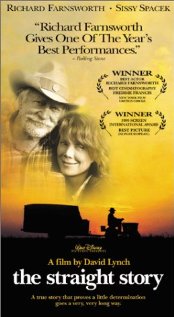
No two David Lynch films can be compared directly, and The Straight Story is no exception.  Based on a real story, The Straight Story follows a Midwestern farmer from Iowa to visit his ill brother in Wisconsin on his only available means of transportation: a John Deere tractor.  Lynch brings

Lynch shows more than tells, letting the events unfold without obvious manipulation by a film director.  Richard Farnsworth plays Alvin Straight, and Sissy Spacek his daughter Rose.  It's still amazing that Farnsworth only began acting in his later years, after spending most of his career as a film stuntman.  This was Farnworth's last film, a poignant reminder of the film's message.

The film's slow pace perfectly accompanies a tractor's pace, capturing the scenery and pride of the rural Midwest, driving past farms and through small towns.  The soundtrack's slow waltzes and fiddle solos provide a beautiful accompaniment, reminiscent of distant trains, both melancholic and joyful.  This is not a road trip to blast the speakers and broadcast the freedom of the open road; it's a contemplative journey to sort out your thoughts and ponder what's most important in life.

July 1, 2011

Paper Moon

Director: Peter Bogdanovich
Released: 1973
Length:


There's something about films in black and white that seems to make them ageless.  Paper Moon was made nearly forty years ago, yet if you saw it today for the first time you'd never guess it.  

Director Peter Bogdanovich perfectly captures the relationship between both main characters, and their verbal exchanges sound impromptu.  Parentage is frequently suggested, but the issue is always skirted.  In the end it doesn't really matter; to the outside world he's her father, and she's ok with it.

Ryan O'Neal and his daughter Tatum portray the same issues of conflict they later struggled with in real life.  

Tatum played her character with such poise and sophistication that she won an Oscar (Best Supporting Actress), even though it was her first film.  She sets the record for youngest person to win an Oscar (she was ten).  

Easy Rider

Director: Dennis Hopper
Released: 1969
Length: 95 min.

What began as revolutionary filmmaking exploring the freedoms of the counter culture has now become the mainstream image of modern road culture. Over the decades, Easy Rider has become reduced to a song (Born to Be Wild) and an image (two chopped motorcycles).    

Dennis Hopper's and Peter Fonda's characters embark on a motorcycle journey across the Southern United States, eventually winding up in New Orleans for Mardi Gras.  Their encounters with people living under the radar present philosophical questions for the mainstream public without preaching.  Potentially offensive aspects of counter culture life confront the viewer directly, almost provoking conflict, yet maintaining a distance.  As the main characters wind their way across the country, they almost seem nostalgic about their journey, almost seem to know this may be their last.

The film opened at the Cannes Film Festival in May 1969 prior to its release two weeks later in the US.  It was made on a very low budget, without much crew, and had tremendous success throughout the world.

Easy Rider marks the end of an era (it was made in 1969); most profoundly by its somewhat bombastic conclusion.  It juxtaposes youthful idealism with apathy, foreshadowing the decades to come, when drugs would be harder, the counter culture more dangerous, and everyone less carefree.  It doesn't question the price of freedom, it throws it in our faces.  

June 15, 2011

Little Miss Sunshine

Director: Jonathan Dayton
Length:
Released: 2006

When first introduced, the mix of characters in Little Miss Sunshine barely function as a family.  A surprise win in a beauty contest throws everyone off guard, suddenly requiring them to drop everything, cancel all plans, and transport their little girl to the pageant (the source of the film's title).  Everyone has an opinion on her participation, but despite contrasting philosophies, ideals and morals, the family develops a crazed commitment to arrive in time for the pageant.

As in any good road trip, it's the adventures along the way that make the story worth telling.  Anyone with a VW bus knows its limitations, and the journey from New Mexico to southern California becomes an odyssey with its moments of comedy and tragedy.  The yellow bus almost seems to smile as it avenges the constant need for speed in the modern world, lamenting the bygone era of travel at a slower pace.

The rich selection of actors in atypical roles demonstrate additional dimensions of their abilities.  Young Paul Dano's reticent teenager, committed to a vow of silence, speaks only through words on his t-shirts and a notepad until halfway through the film, when he releases all his bottled-up emotions.  Abigail Breslin plays his sister, the young heroine determined to follow her dreams, unaware of how they may look to the rest of the world.  Toni Collette and  Greg Kinnear play their parents, trying to hold the family together, which includes Steve Carrell (proving he's more than a comedian) as an uncle recently released on parole, and Alan Arkin (who won an Oscar) as the grandfather, the most supportive of his granddaughter's interest in the pageant).  

The unanticipated road trip throws everyone's personalities, fears and quirks in a confined space.  The family learns to accept and appreciate what each person contributes, and ironically it is their most naïve member who proves wisest, pursuing her own path rather than be led by others (as they all initially assume).

Little Miss Sunshine makes you laugh, cheer, and even cry.  Even the most dysfunctional families have a bond, and this film lets its characters explore their differences before bringing them back together.
Their collective values are manifested in their little girl's dance at the beauty pageant.  The absurdity of their presence is overruled by pride for her individuality, and their shared adventures draw them together as a family once again.

The way this small film became a sensational hit is the type of Cinderella story that keeps indie filmmakers pursuing their dreams.  Little Miss Sunshine won hearts, awards, and success at the box office.  Michael Arndt won an Oscar for his original screenplay, initially written in three days.  Alan Arkin won an Oscar, and Abigail Breslin was nominated.

Official website

June 7, 2011

Smoke Signals

Director:  Chris Eyre
Length:  89 min.
Released:  1998

Not very many films portray life as a Native American from an Indian perspective, and few take place in modern day.  Smoke Signals is a rare gem, because it is not a film about Indians but about life, about trying to figure out who you are and whether to be proud of or humiliated by your past.

The story centers on the relationship between Victor and Thomas, best friends on the reservation where they live in Eastern Washington.  Thomas is a natural-born storyteller, and Evan Adam's narrative style and voice fluctuations are captivating.  Adam Beach is a familiar face, and he does an excellent job conveying Victor's angst.  

Thomas is an orphan raised by his grandmother who views Victor's father as a hero.  Victor only sees the alcoholism, abuse and eventual abandonment when his father left.  Thomas convinces Victor to travel south to Arizona and find him again, and the two embark on a road trip adventure to salvage the relationship before it's too late.

Victor and Thomas perceive themselves differently, a thread which carries throughout the film.
Victor instructs Thomas how to conform to expectations of what it means to be "Indian".  Smiling Thomas with glasses is not the stoic Indian Victor thinks one must be.  Other potential sources of conflict are met with humor, and told from a perspective of a generation far removed from the emotional and physical attachment once felt.  This direct confrontation of stereotypes points out their inaccuracies, relieves tension and moves the characters beyond the token status minorities usually receive.

As road trip films often do, it's more about the journey than the destination, and along the way Victor finds peace with himself and his father.  Thomas also discovers his place in the world.  Smoke Signals is funny, poignant, and informative.  It won many awards at independent film festivals.

The woman on the poster is a minor character, and I find it unfortunate that a film about two young men feels the necessity to show a female just to garner sex appeal.  I wish we could see Evan Adam's "frybread power" t-shirt more clearly.

Director Chris Eyre (himself a member of the Cheyenne/Arapaho nation) collaborated with Sherman Alexie (a highly regarded poet, essayist, and public speaker who grew up on an Indian reservation in Eastern Washington state) to turn one of Alexie's short stories into a film.  (Alexie's following project was his directorial debut, The Business of Fancydancing, based on a collection of his poetry, also about modern Indians in Washington.)


May 20, 2011

Top 5 Films About...Birthdays

In the spirit of High Fidelity and the main character's obsession with Top 5 lists, I have decided to compile some lists of films by category.  Five is a good limit, because it makes you choose your favorites, and sometimes there aren't that many on the subject.  Look for the lists to appear at various times throughout the year...    

I'll begin with birthdays, because today is mine.

TOP 5 FILMS ABOUT BIRTHDAYS
1.  Sixteen Candles
2.  13 Going on 30
3.  Logan's Run
4.  To Gillian on her 37th Birthday
5.  The Great Gatsby
 
The theme here seems to be "forgetting birthdays", because they seem to all have to do with characters forgetting about someone's birthday.

Contribute your list!  (Remember, only five!)

High Fidelity

Director: Stephen Frears
Length: 113 min. 
Released: 2000

High Fidelity is a trip down memory lane for those nostalgic about lost love, record collections, and the freedom of not working a desk job.  


John Cusack seems to fall into characters unsure whether to stay put or run away.  His character in High Fidelity views life in terms of music, and supports his massive record collection by running an independent record store.  His two employees are played by Jack Black and Todd Louiso.  Black plays his snobbish character with so much enthusiasm you accept him as being simply eccentric, but it's Louiso's understated charm which gets him the girlfriend and the great one-liners.     


The film introduced many people to Nick Hornby, the English author who wrote the book on which the film is based.  Cusack, originally from Chicago, moved the story from London suburbs to more familiar ground outside Chicago.  Some of the English musical references have been changed for an American audience, but relationship troubles are universal, and the rest of the story is intact.  Hornby's own appreciation for music  and his characters use music as their form of communication,  examines life from a musical perspective, and his characters use music to interact with other people in their lives.  The soundtrack is a sampling of rock and indie bands both old and new, the type of selection you would expect to hear playing in an independent record shop.  Mirroring the plot, these songs of frustration, confusion and attempts at love express the characters' emotions better than they can.  


As in many Cusack films, his sister Joan and Lili Taylor coax him through his relationship foibles, along with the past women in his life, played by such actresses as Catherine Zeta-Jones and Lisa Bonet (best-known for her role on The Cosby Show).  Tim Robbins makes an appearance as an egocentric in a different type of role for him.  


High Fidelity should be viewed as a time capsule of sorts, as it captures an earlier moment in time.  Less and less people physically go to small independent music stores to buy their music, few buy actual records, many don't the sound quality difference, and the new generation doesn't know them at all.  But in high contrast to the proliferation of cheap digital media, people are still interested in vinyl, and they continue to have their popularity, albeit cultish.  And isn't that some sort of success anyway? 

May 18, 2011

Everything is Illuminated

Director: Liev Schreiber
Length: 106 min.
Released: 2005

Everything is Illuminated takes place in Ukraine, one of the former Eastern Bloc countries now poor, but independent.  When the Soviet Union fell apart, Ukrainians threw off the heavy cloak of communism in order to embrace capitalism, and many of its citizens try to make money however possible.  One such way is to guide Americans making nostalgic trips back to the mother country to see how previous generations lived.

The film was adapted from the novel by Jonathan Safran Foer.  Foer studied philosphy and traveled to Ukraine to learn more about his grandfather, a Holocaust survivor.  The subject for his college thesis later became his first novel, Everything is Illuminated.  The actor Liev Schreiber wrote the screen adaptation and directed the film.  (Although Schreiber is American, he is of mixed Central-European heritage, and his maternal grandfather was from Ukraine, just like Foer.)    

Foer is played by Elijah Wood, who goes to Ukraine to unveil a mystery about his grandfather.  His collecting habits and quirks provide interesting encounters with the people he meets along his journey.
One of the most memorable characters is Alex (played by Eugene Hutz, frontman of the gypsy punk band Gogol Bordello), Foer's driver on his odyssey across the Ukrainian countryside.  Alex is part of the new generation embracing Western culture.  

Everything is Illuminated does not demand pity or anger for what has happened in the past. It is the story of one man's connection to his own family history.  The film becomes more and more surrealistic, as past events appear in dream-like sequences mix with present-day.

The score by Paul Cantelon is an excellent introduction to Eastern European music, and holds its own beyond the film.  It is especially interesting the way the theme is played many ways: with different instrumentation and different feels.  Independent films don't always produce a soundtrack, but I was pleasantly surprised to find it at my local library.  (To hear samples of the soundtrack, click here.)

An interesting sidenote about this film: PBS aired a documentary a few years ago about a young Iraqi man who received an internship from Liev Schreiber to work on Everything is Illuminated.  The documentary takes its own path, but gives an interesting perspective of the themes from Schreiber's film in a different context.  The documentary is called Operation Filmmaker and is done by Nina Davenport (who also made Parallel Lines).   

May 16, 2011

The Triplets of Belleville

Original Title: Les Triplettes de Belleville
Director: Sylvain Chomet
Length: 80 min.
Released: 2003


Sylvain Chomet has a unique eye.  His animation studio created a dynamic film both charming and critical of modern society at the same time.  Characters drawn with exaggerated features highlight their movements and personalities.  Chomet succeeds in telling a story with a full range of human emotions through two-dimensional characters, almost entirely without dialogue.  

The film's main story line centers around a grandmother, her grandson, and their dog.  Chomet, a devoted fan of bicycling, chose to make an homage to old-school bike racing.  His main character, named Champion, is drawn to resemble the famous French racer Jacques Anquetil, and he participates in the Tour de France.  He is kidnapped by the Mafia (drawn as large black blocks), who have their own uses for bike racers, and taken to Belleville.  His grandmother and dog set off on an adventure to rescue him.   

A set of three singing sisters make up the title of the film and are a sort of Greek chorus.  Music used in the film evokes jazz and swing, and was immensely popular (and nominated for an Academy Award).  Caricatures of popular musicians in France can be seen in several scenes.

Chomet has tried to make the film not set in any specific country, but it begins in France, and then crosses the Atlantic to Belleville, clearly a large North American city.  The film was produced as a collaboration between several countries (Belgium, the United Kingdom, the United States and Canada), and Chomet seems to give them all a potential role in the film.

The Triplets of Belleville is charming, even in its sharp lines and sharp criticisms.  Bruno (the dog) has some of the best scenes, and the grandmother is everything a maternal figure should be.  Chomet has moved animated films beyond the realm of children's entertainment, and has made a work unique in genre and technique.  The film was also nominated for Best Animated Feature Film, but it lost to Finding Nemo.  (Tough competition: it's hardly fair to expect an innovative film to beat out a Disney/Pixar one).

Film Info

Meek's Cutoff

Director: Kelly Reichardt
Length: 104 min.
Released: 2010


Pioneers on the Oregon Trail traversed thousands of miles on foot, dreaming of a better life out West.  They often hired men with knowledge of the frontier to serve as guides and for protection.  These outdoor enthusiasts, mountain men, and outlaws had abandoned genteel society in order to be free and independent.  Their adventurous and thrill-seeking spirits contrasted with families, where the presence of women and children brought morals and social structures to new territories.

Meek's Cutoff tells the story of a small group on the Oregon Trail in 1845.  Their guide, Stephen Meek, leads the three-wagon train across dry, hot and sparse Eastern Oregon, telling them tales of his adventures in the Wild West.  His optimism and wilderness experience convince him and the others that water and the fertile Willamette Valley is within easy reach.  At that time, early in the westward movement, it was hard even for a guide to know the valley of their dreams lay hundreds of miles further west, and the Columbia River several hundred miles north.  


An encounter with an indian causes the group to question their leader and their own inner fears.  Relations between native tribes and whites were often based on experiences and stories of murder and raids on both sides.  Fear dictated behavior, and few people were aware of the diversity of tribes across North America.  Travel in stressful situations brings out true personalities, and misunderstandings and stereotypes led to a confrontation without resolution for the Meek party.  The film becomes a study in social nature and foreshadows changes in the American West.   

Panoramic scenic shots held for a long time are reminiscent of such David Lean films as Doctor Zhivago and Lawrence of Arabia.  A pastel color scheme complements the characters with the world around them: beautiful, but desolate.  There are only a handful of characters, but each is memorable and plays an important role in this microcosm of society.  One of the more unique aspects of the film is its square frame, designed to represent the view from inside a woman's bonnet.  This is not a restrictive gimmick, but a thoughtful depiction of a confined viewpoint.  There are feminist overtones to the film, written by Jon Raymond and directed by Kelly Reichardt, whose previous films also explore themes of social behavior, two of which are also set in Oregon.     


The film is carefully detailed, and moves at a pace that brings you back to a different time.  Setting up camp, eating dinner in the dark, waking before dawn, walking all day and setting up a new camp clearly demonstrate the monotony of life on the trail.  It's a road movie told not with the enthusiasm of a journey's beginning, but with the hardened disillusion of being lost so near the destination.  Music used in the film is simplistic but evocative, typical of recent films set in the West.  Sound effects are natural and part of the scenery: a squeaky wagon wheel, birds hovering overhead, fabric rustling in the wind.  The ending leaves you wanting to know more about these people and their story. 


The Oregon Trail is frequently romanticized, but Meek's Cutoff depicts the reality of the journey so many people took.  Travel has become so simplified over the centuries, it's good to be reminded how difficult it used to be, when so much was up to chance.  The vast migration west may have been imperialistic, but we must still give the people who did it credit for their strength, courage and perseverance.  


Official Website