Director: Alejandro Gonzalez Inarritu
Length: 148 min.
Released: 2010
The latest film from the Mexican director Alejandro Gonzalez IƱarritu received much critical acclaim. Innaritu's films tend to use multiple character subplots concentric or overlapping circles to tell a larger story. As he did in Babel, Innaritu uses several different cultural groups, but in Biutiful he places them all in the same city (Barcelona).
Inarritu sets his story in a world invisible to most people. His main character, Uxbal (played by Javier Bardem, who was nominated for an Oscar), is a go-between for several illegal operations: Chinese sweat-shops, operating a sweat-shop warehouse who pay the Spanish police to
Uxbal also earns a little money as a medium helping people interpret the last needs of their loved ones as they die.
He does his best to help people, but sometimes things go horribly wrong. His personal life takes a bad turn, as a bladder problem becomes much more serious. He worries that his wife, who suffers from manic depression, will not be able to care for their two young children. He is unable to confide in his brother, who is involved in other projects: drugs, strip clubs, and construction. The cemetery where their father is buried will be turned into a shopping center, and the body must be cremated.
All the characters in Biutiful struggle to keep themselves afloat. They are doing the best they can to survive. It is easy to criticize from a distance and say the characters are part of a seedy underground, that the have made bad choices. These people are doing the best they can with the resources they have.
Most of the scenes take place inside: in basement warehouses, in cramped and dirty apartments, in hospitals. For many of these people, being outside means being exposed and vulnerable. One of the few scenes outside takes place on a major square where illegal African immigrants sell goods (illegally-manufactured by the Chinese illegal immigrants in the sweat-shop warehouses). The police arrive in a major raid, causing a chain of events which leads to a breakdown in the whole operation.
Showing posts with label drama. Show all posts
May 28, 2017
November 2, 2011
Wilby Wonderful
Director: Daniel MacIvor
Length: 99 min.
Released: 2004
Length: 99 min.
Released: 2004
Quirky towns always make popular settings for films. Wilby Wonderful follows a group of characters and interwoven characters through a single somewhat ordinary day. Wilby is a small town, on a little island where residents view anyone not born and raised on the island as a foreigner. The story is set in Canada, but the conflicts within the film are so universal that it could take place anywhere. Canadian actors populate the film, and a few who have become very famous in the US (Sandra Oh and Ellen Page). As in many stories, each character evolves over the day and becomes a better and more whole member of the community. The well-written screenplay brings Wilby to life, and even though the entire film takes place in only one day, we have lived something with the characters. Wilby Wonderful challenges its characters to move beyond themselves in order find their place and purpose within the community. The fact that the title sounds like "we'll be wonderful" is another fringe benefit of an already good title, presented in the film as a banner for an upcoming town festival which was printed backwards. Quirky music fills the soundtrack. Wilby Wonderful is a gem.
August 6, 2011
Black Swan
Director: Darren Aronofsky
Length: 108 min.
Released: 2010
Darren Aronofsky's latest film received much critical acclaim. Aronofsky seems to enjoy exploring the human psyche. In Black Swan, he concentrates on the world of classical ballet, and the competition within a company for lead and principal roles.
Natalie Portman plays Nina, a young ballet dancer who has worked her way up in the ranks of a professional company in a large metropolitan city. She lives with her mother (played by Barbara Hershey), who pushes to make sure her daughter gets to be the professional dancer she herself was unable to be. Nina struggles to emerge from under the wing of her overprotective mother. The directory of the company (played by French actor Vincent Cassel) wants her to play the Swan Queen in Swan Lake, which will require her to play both the white swan (innocent and beautiful), and the black swan (mysterious and passionate). To secure the coveted role, Nina begins a dark path of exploration, but starts to lose her footing. Portman plays the lead role
A dancer brought in from San Francisco (played by Mila Kunis) provides added pressure and competition. She seems to possess all the required characteristics needed for the Swan Queen role, which Nina views as a direct threat. Kunis' plays her character as both friendly and menacing, keeping the viewer guessing. Winona Ryder has a small part as the former prima ballerina displaced in favor of younger, more agile dancers, despite her own youth. Nina's empathy for her situation foreshadows her own turn in the same position.
Aronofsky slowly blurs the lines separating reality from imagined sequences, and at the end we are left questioning what was real and what was not. The film is certainly a psychological thriller, but is not a "psycho-sexual thriller", the way some critics claim.
Aronofsky shows the world within a professional dance company as cold and fickle as the winter wind. Despite their immense strength, the ease with which dancers can injure themselves and their vulnerability to scrutiny reveals an underlying general frailty of being human. The catty competitiveness between the young female dancers reduces their abilities to support one another as a family. Just as the line is blurred between reality and delusion, so too is the line between friend and enemy.
Aronofsky drives his film like a roller-coaster, with twists and lurches along the way. The actors convey their world with realism. The use of black and white as the color palette throughout the film is very effective. Strong patterns in black and white dominate the film. There is only some pink in Nina's apartment (evoking purity). The music conveys tension and propels the story forward. Tchaikovsky's score to Swan Lake provides certain scenes with extra emotion. (Although used for dramatic effect, the scene where Kunis eats a hamburger is unrealistic; dancers are unable to consume that much fat, especially during a performance season. She only ate one bite, however this was not the message conveyed.)
Like a true Grimm fairy tale, the film is dark but not morbid, and gripping but not scary. There is no moral at the end, but no happily-ever-after ending either. After several surprise twists, the film arrives at its conclusion, leaving the viewer with much to ponder.
Length: 108 min.
Released: 2010
Darren Aronofsky's latest film received much critical acclaim. Aronofsky seems to enjoy exploring the human psyche. In Black Swan, he concentrates on the world of classical ballet, and the competition within a company for lead and principal roles.
Natalie Portman plays Nina, a young ballet dancer who has worked her way up in the ranks of a professional company in a large metropolitan city. She lives with her mother (played by Barbara Hershey), who pushes to make sure her daughter gets to be the professional dancer she herself was unable to be. Nina struggles to emerge from under the wing of her overprotective mother. The directory of the company (played by French actor Vincent Cassel) wants her to play the Swan Queen in Swan Lake, which will require her to play both the white swan (innocent and beautiful), and the black swan (mysterious and passionate). To secure the coveted role, Nina begins a dark path of exploration, but starts to lose her footing. Portman plays the lead role
A dancer brought in from San Francisco (played by Mila Kunis) provides added pressure and competition. She seems to possess all the required characteristics needed for the Swan Queen role, which Nina views as a direct threat. Kunis' plays her character as both friendly and menacing, keeping the viewer guessing. Winona Ryder has a small part as the former prima ballerina displaced in favor of younger, more agile dancers, despite her own youth. Nina's empathy for her situation foreshadows her own turn in the same position.
Aronofsky slowly blurs the lines separating reality from imagined sequences, and at the end we are left questioning what was real and what was not. The film is certainly a psychological thriller, but is not a "psycho-sexual thriller", the way some critics claim.
Aronofsky shows the world within a professional dance company as cold and fickle as the winter wind. Despite their immense strength, the ease with which dancers can injure themselves and their vulnerability to scrutiny reveals an underlying general frailty of being human. The catty competitiveness between the young female dancers reduces their abilities to support one another as a family. Just as the line is blurred between reality and delusion, so too is the line between friend and enemy.
Aronofsky drives his film like a roller-coaster, with twists and lurches along the way. The actors convey their world with realism. The use of black and white as the color palette throughout the film is very effective. Strong patterns in black and white dominate the film. There is only some pink in Nina's apartment (evoking purity). The music conveys tension and propels the story forward. Tchaikovsky's score to Swan Lake provides certain scenes with extra emotion. (Although used for dramatic effect, the scene where Kunis eats a hamburger is unrealistic; dancers are unable to consume that much fat, especially during a performance season. She only ate one bite, however this was not the message conveyed.)
Like a true Grimm fairy tale, the film is dark but not morbid, and gripping but not scary. There is no moral at the end, but no happily-ever-after ending either. After several surprise twists, the film arrives at its conclusion, leaving the viewer with much to ponder.
July 13, 2011
The Motorcycle Diaries
Original Title: Diarios de motocicleta
Director: Walter Salles
Released: 2004
Length: 126 min.
The Motorcycle Diaries depicts the journey Ernesto "Che" Guevara and his best friend Alberto Granada took by motorcycle from Argentina to Venezuela in 1952 and is based on books written by both Che and Granada.
Gael Garcia Bernal as Che and Rodrigo de la Serna as Alberto perfectly capture the innocence, enthusiasm, brashness and idealism of youth. The fact that the moto is old and that they lack money forces them to stop frequently, and their encounters with people from many different backgrounds introduces them to prejudice and injustice in many forms. It was this journey that determined the future paths of Ernesto and Alberto; Alberto to improve medicinal treatment in poor areas, and Ernesto to instigate social and political change throughout South America.
Walter Salle perfectly captures the natural beauty and cultural diversity of South America. Gustavo Santaoallalo's guitar solos in the score complement the film well, as a guitar often provides nice accompaniment on a long journey.
The Motorcycle Diaries is part travelogue, part adventure, and part documentary. It portrays the humor between two close friends exploring together, and the escapades they encounter on a road trip.
Director: Walter Salles
Released: 2004
Length: 126 min.
The Motorcycle Diaries depicts the journey Ernesto "Che" Guevara and his best friend Alberto Granada took by motorcycle from Argentina to Venezuela in 1952 and is based on books written by both Che and Granada.
Gael Garcia Bernal as Che and Rodrigo de la Serna as Alberto perfectly capture the innocence, enthusiasm, brashness and idealism of youth. The fact that the moto is old and that they lack money forces them to stop frequently, and their encounters with people from many different backgrounds introduces them to prejudice and injustice in many forms. It was this journey that determined the future paths of Ernesto and Alberto; Alberto to improve medicinal treatment in poor areas, and Ernesto to instigate social and political change throughout South America.
Walter Salle perfectly captures the natural beauty and cultural diversity of South America. Gustavo Santaoallalo's guitar solos in the score complement the film well, as a guitar often provides nice accompaniment on a long journey.
The Motorcycle Diaries is part travelogue, part adventure, and part documentary. It portrays the humor between two close friends exploring together, and the escapades they encounter on a road trip.
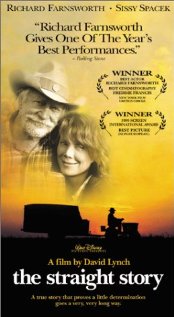
The Straight Story
Director: David Lynch
Length: 112 min.
Released: 1999
No two David Lynch films can be compared directly, and The Straight Story is no exception. Based on a real story, The Straight Story follows a Midwestern farmer from Iowa to visit his ill brother in Wisconsin on his only available means of transportation: a John Deere tractor. Lynch brings
Lynch shows more than tells, letting the events unfold without obvious manipulation by a film director. Richard Farnsworth plays Alvin Straight, and Sissy Spacek his daughter Rose. It's still amazing that Farnsworth only began acting in his later years, after spending most of his career as a film stuntman. This was Farnworth's last film, a poignant reminder of the film's message.
The film's slow pace perfectly accompanies a tractor's pace, capturing the scenery and pride of the rural Midwest, driving past farms and through small towns. The soundtrack's slow waltzes and fiddle solos provide a beautiful accompaniment, reminiscent of distant trains, both melancholic and joyful. This is not a road trip to blast the speakers and broadcast the freedom of the open road; it's a contemplative journey to sort out your thoughts and ponder what's most important in life.
Length: 112 min.
Released: 1999
No two David Lynch films can be compared directly, and The Straight Story is no exception. Based on a real story, The Straight Story follows a Midwestern farmer from Iowa to visit his ill brother in Wisconsin on his only available means of transportation: a John Deere tractor. Lynch brings
Lynch shows more than tells, letting the events unfold without obvious manipulation by a film director. Richard Farnsworth plays Alvin Straight, and Sissy Spacek his daughter Rose. It's still amazing that Farnsworth only began acting in his later years, after spending most of his career as a film stuntman. This was Farnworth's last film, a poignant reminder of the film's message.
The film's slow pace perfectly accompanies a tractor's pace, capturing the scenery and pride of the rural Midwest, driving past farms and through small towns. The soundtrack's slow waltzes and fiddle solos provide a beautiful accompaniment, reminiscent of distant trains, both melancholic and joyful. This is not a road trip to blast the speakers and broadcast the freedom of the open road; it's a contemplative journey to sort out your thoughts and ponder what's most important in life.
July 1, 2011
Easy Rider
Director: Dennis Hopper
Released: 1969
Length: 95 min.
What began as revolutionary filmmaking exploring the freedoms of the counter culture has now become the mainstream image of modern road culture. Over the decades, Easy Rider has become reduced to a song (Born to Be Wild) and an image (two chopped motorcycles).
Dennis Hopper's and Peter Fonda's characters embark on a motorcycle journey across the Southern United States, eventually winding up in New Orleans for Mardi Gras. Their encounters with people living under the radar present philosophical questions for the mainstream public without preaching. Potentially offensive aspects of counter culture life confront the viewer directly, almost provoking conflict, yet maintaining a distance. As the main characters wind their way across the country, they almost seem nostalgic about their journey, almost seem to know this may be their last.
The film opened at the Cannes Film Festival in May 1969 prior to its release two weeks later in the US. It was made on a very low budget, without much crew, and had tremendous success throughout the world.
Easy Rider marks the end of an era (it was made in 1969); most profoundly by its somewhat bombastic conclusion. It juxtaposes youthful idealism with apathy, foreshadowing the decades to come, when drugs would be harder, the counter culture more dangerous, and everyone less carefree. It doesn't question the price of freedom, it throws it in our faces.
Released: 1969
Length: 95 min.
What began as revolutionary filmmaking exploring the freedoms of the counter culture has now become the mainstream image of modern road culture. Over the decades, Easy Rider has become reduced to a song (Born to Be Wild) and an image (two chopped motorcycles).
Dennis Hopper's and Peter Fonda's characters embark on a motorcycle journey across the Southern United States, eventually winding up in New Orleans for Mardi Gras. Their encounters with people living under the radar present philosophical questions for the mainstream public without preaching. Potentially offensive aspects of counter culture life confront the viewer directly, almost provoking conflict, yet maintaining a distance. As the main characters wind their way across the country, they almost seem nostalgic about their journey, almost seem to know this may be their last.
The film opened at the Cannes Film Festival in May 1969 prior to its release two weeks later in the US. It was made on a very low budget, without much crew, and had tremendous success throughout the world.
Easy Rider marks the end of an era (it was made in 1969); most profoundly by its somewhat bombastic conclusion. It juxtaposes youthful idealism with apathy, foreshadowing the decades to come, when drugs would be harder, the counter culture more dangerous, and everyone less carefree. It doesn't question the price of freedom, it throws it in our faces.
May 2, 2011
Elizabethtown
Director: Cameron Crowe
Length: 123 min.
Released: 2005
Released: 2005
It doesn't get much better than Cameron Crowe. With his latest creation, Elizabethtown, everything's there: comedy, drama, a road trip, family values and feuds, satire, and music. Unfortunately, the box office didn't reflect this total package, but when has that ever happened to Crowe? The public, it appears, has yet to appreciate his prowess. His love of music means there's a perfect song for every moment of the film. Luckily for us (few) fans, he decided to produce a truly memorable two volume soundtrack, despite the film's lackluster success. Tom Petty has a prominent place, as he always does in Crowe films, as well as Crowe's wife, Nancy Wilson, who provides several of the themes.
| Soundtrack, Vol. 1 |
| Soundtrack, Vol. II |
Elizabethtown is another Cameron Crowe masterpiece that perfectly captures small-town America and the difficulties of family. A must-see for anyone.
Subscribe to:
Posts (Atom)