August 6, 2011

Western

Director:  Manuel Poirier
Length: 124 min.
Released:  1997


Europeans have a fascination with the American West, but this film gets its title from Bretagne, a region in Northwest France where this film takes place.  The story centers around two characters, both foreigners.  Paco is a Catalan in France on a business trip as a shoe representative, and Nino is a Russian hitchhiking his way around Europe.  Paco's initial goodwill to help Nino causes him nothing but problems, when he loses everything: his car, his wares. even his job.  But being stuck in a small French village has its upsides, as he meets a beautiful woman willing to help him.  Finding Nino, and restoring his life again become his highest priority, but he begins to change his opinion of Nino.

As catastrophes continue to cause Paco grief, he begins to adopt some of Nico's carefree nature.  Losing everything multiple times forms a bond between the two, who become friends.  In one of his first roles,   Sergi Lopez often plays villains, but he shows he's a more well-rounded actor with his portrayal of Paco.  French director Manuel Poirier has used him in several of his films, always playing a lost Spaniard in France.  Sacha Bourdo, a Russian-born actor popular in many French films, shows Nino is an intelligent and thoughtful individual, more a wandering philosopher than a vagrant gypsy.  

Western uses its foreign characters to tell a multicultural story, but it is not about the difficulties of being a stranger in a strange land.  Its characters reveal and challenge cultural stereotypes, and engage in real discussions about life and modern society.  The characters grow on each other, and we grow with them.

Western is charming.  It seems to say with a sense of humor you will get through anything, and live better.  The film won the Jury prize at the Cannes film festival.    

July 13, 2011

The Motorcycle Diaries

Original Title:  Diarios de motocicleta
Director:  Walter Salles
Released:  2004
Length: 126 min.

The Motorcycle Diaries depicts the journey Ernesto "Che" Guevara and his best friend Alberto Granada took by motorcycle from Argentina to Venezuela in 1952 and is based on books written by both Che and Granada.

Gael Garcia Bernal as Che and Rodrigo de la Serna as Alberto perfectly capture the innocence, enthusiasm, brashness and idealism of youth.  The fact that the moto is old and that they lack money forces them to stop frequently, and their encounters with people from many different backgrounds introduces them to prejudice and injustice in many forms.  It was this journey that determined the future paths of Ernesto and Alberto;  Alberto to improve medicinal treatment in poor areas, and Ernesto to instigate social and political change throughout South America.

Walter Salle perfectly captures the natural beauty and cultural diversity of South America.  Gustavo Santaoallalo's guitar solos in the score complement the film well, as a guitar often provides nice accompaniment on a long journey.

The Motorcycle Diaries is part travelogue, part adventure, and part documentary.  It portrays the humor between two close friends exploring together, and the escapades they encounter on a road trip.

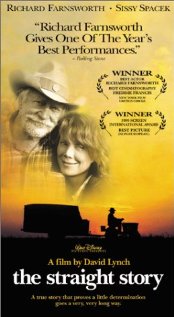
The Straight Story

Director:  David Lynch
Length: 112 min.
Released:  1999

No two David Lynch films can be compared directly, and The Straight Story is no exception.  Based on a real story, The Straight Story follows a Midwestern farmer from Iowa to visit his ill brother in Wisconsin on his only available means of transportation: a John Deere tractor.  Lynch brings

Lynch shows more than tells, letting the events unfold without obvious manipulation by a film director.  Richard Farnsworth plays Alvin Straight, and Sissy Spacek his daughter Rose.  It's still amazing that Farnsworth only began acting in his later years, after spending most of his career as a film stuntman.  This was Farnworth's last film, a poignant reminder of the film's message.

The film's slow pace perfectly accompanies a tractor's pace, capturing the scenery and pride of the rural Midwest, driving past farms and through small towns.  The soundtrack's slow waltzes and fiddle solos provide a beautiful accompaniment, reminiscent of distant trains, both melancholic and joyful.  This is not a road trip to blast the speakers and broadcast the freedom of the open road; it's a contemplative journey to sort out your thoughts and ponder what's most important in life.

July 1, 2011

Paper Moon

Director: Peter Bogdanovich
Released: 1973
Length:


There's something about films in black and white that seems to make them ageless.  Paper Moon was made nearly forty years ago, yet if you saw it today for the first time you'd never guess it.  

Director Peter Bogdanovich perfectly captures the relationship between both main characters, and their verbal exchanges sound impromptu.  Parentage is frequently suggested, but the issue is always skirted.  In the end it doesn't really matter; to the outside world he's her father, and she's ok with it.

Ryan O'Neal and his daughter Tatum portray the same issues of conflict they later struggled with in real life.  

Tatum played her character with such poise and sophistication that she won an Oscar (Best Supporting Actress), even though it was her first film.  She sets the record for youngest person to win an Oscar (she was ten).  

Easy Rider

Director: Dennis Hopper
Released: 1969
Length: 95 min.

What began as revolutionary filmmaking exploring the freedoms of the counter culture has now become the mainstream image of modern road culture. Over the decades, Easy Rider has become reduced to a song (Born to Be Wild) and an image (two chopped motorcycles).    

Dennis Hopper's and Peter Fonda's characters embark on a motorcycle journey across the Southern United States, eventually winding up in New Orleans for Mardi Gras.  Their encounters with people living under the radar present philosophical questions for the mainstream public without preaching.  Potentially offensive aspects of counter culture life confront the viewer directly, almost provoking conflict, yet maintaining a distance.  As the main characters wind their way across the country, they almost seem nostalgic about their journey, almost seem to know this may be their last.

The film opened at the Cannes Film Festival in May 1969 prior to its release two weeks later in the US.  It was made on a very low budget, without much crew, and had tremendous success throughout the world.

Easy Rider marks the end of an era (it was made in 1969); most profoundly by its somewhat bombastic conclusion.  It juxtaposes youthful idealism with apathy, foreshadowing the decades to come, when drugs would be harder, the counter culture more dangerous, and everyone less carefree.  It doesn't question the price of freedom, it throws it in our faces.  

June 15, 2011

Little Miss Sunshine

Director: Jonathan Dayton
Length:
Released: 2006

When first introduced, the mix of characters in Little Miss Sunshine barely function as a family.  A surprise win in a beauty contest throws everyone off guard, suddenly requiring them to drop everything, cancel all plans, and transport their little girl to the pageant (the source of the film's title).  Everyone has an opinion on her participation, but despite contrasting philosophies, ideals and morals, the family develops a crazed commitment to arrive in time for the pageant.

As in any good road trip, it's the adventures along the way that make the story worth telling.  Anyone with a VW bus knows its limitations, and the journey from New Mexico to southern California becomes an odyssey with its moments of comedy and tragedy.  The yellow bus almost seems to smile as it avenges the constant need for speed in the modern world, lamenting the bygone era of travel at a slower pace.

The rich selection of actors in atypical roles demonstrate additional dimensions of their abilities.  Young Paul Dano's reticent teenager, committed to a vow of silence, speaks only through words on his t-shirts and a notepad until halfway through the film, when he releases all his bottled-up emotions.  Abigail Breslin plays his sister, the young heroine determined to follow her dreams, unaware of how they may look to the rest of the world.  Toni Collette and  Greg Kinnear play their parents, trying to hold the family together, which includes Steve Carrell (proving he's more than a comedian) as an uncle recently released on parole, and Alan Arkin (who won an Oscar) as the grandfather, the most supportive of his granddaughter's interest in the pageant).  

The unanticipated road trip throws everyone's personalities, fears and quirks in a confined space.  The family learns to accept and appreciate what each person contributes, and ironically it is their most naïve member who proves wisest, pursuing her own path rather than be led by others (as they all initially assume).

Little Miss Sunshine makes you laugh, cheer, and even cry.  Even the most dysfunctional families have a bond, and this film lets its characters explore their differences before bringing them back together.
Their collective values are manifested in their little girl's dance at the beauty pageant.  The absurdity of their presence is overruled by pride for her individuality, and their shared adventures draw them together as a family once again.

The way this small film became a sensational hit is the type of Cinderella story that keeps indie filmmakers pursuing their dreams.  Little Miss Sunshine won hearts, awards, and success at the box office.  Michael Arndt won an Oscar for his original screenplay, initially written in three days.  Alan Arkin won an Oscar, and Abigail Breslin was nominated.

Official website

June 7, 2011

Smoke Signals

Director:  Chris Eyre
Length:  89 min.
Released:  1998

Not very many films portray life as a Native American from an Indian perspective, and few take place in modern day.  Smoke Signals is a rare gem, because it is not a film about Indians but about life, about trying to figure out who you are and whether to be proud of or humiliated by your past.

The story centers on the relationship between Victor and Thomas, best friends on the reservation where they live in Eastern Washington.  Thomas is a natural-born storyteller, and Evan Adam's narrative style and voice fluctuations are captivating.  Adam Beach is a familiar face, and he does an excellent job conveying Victor's angst.  

Thomas is an orphan raised by his grandmother who views Victor's father as a hero.  Victor only sees the alcoholism, abuse and eventual abandonment when his father left.  Thomas convinces Victor to travel south to Arizona and find him again, and the two embark on a road trip adventure to salvage the relationship before it's too late.

Victor and Thomas perceive themselves differently, a thread which carries throughout the film.
Victor instructs Thomas how to conform to expectations of what it means to be "Indian".  Smiling Thomas with glasses is not the stoic Indian Victor thinks one must be.  Other potential sources of conflict are met with humor, and told from a perspective of a generation far removed from the emotional and physical attachment once felt.  This direct confrontation of stereotypes points out their inaccuracies, relieves tension and moves the characters beyond the token status minorities usually receive.

As road trip films often do, it's more about the journey than the destination, and along the way Victor finds peace with himself and his father.  Thomas also discovers his place in the world.  Smoke Signals is funny, poignant, and informative.  It won many awards at independent film festivals.

The woman on the poster is a minor character, and I find it unfortunate that a film about two young men feels the necessity to show a female just to garner sex appeal.  I wish we could see Evan Adam's "frybread power" t-shirt more clearly.

Director Chris Eyre (himself a member of the Cheyenne/Arapaho nation) collaborated with Sherman Alexie (a highly regarded poet, essayist, and public speaker who grew up on an Indian reservation in Eastern Washington state) to turn one of Alexie's short stories into a film.  (Alexie's following project was his directorial debut, The Business of Fancydancing, based on a collection of his poetry, also about modern Indians in Washington.)